
For a long time, there has been uncertainty within the SEO world about how Google views AI-generated images. The question has been whether they risk lowering a website’s ranking or if they are a tool that can be used strategically. Now Google has clearly confirmed that AI images do not cause any direct negative impact on search results – on the contrary, in some cases they can increase traffic.
Table of content
No direct ranking penalties for AI images
In a recent Q&A session, Google analyst Gary Illyes was asked whether AI-generated images can lead to worse rankings.
His answer was clear:
“No, no. So AI generated image doesn’t impact the SEO. Not direct.
So obviously when you put images on your site, you will have to sacrifice some resources to those images… But otherwise you are not going to, I don’t think that you’re going to see any negative impact from that.
If anything, you might get some traffic out of image search or video search or whatever, but otherwise it should just be fine.”
This means that the origin of the image is not decisive for Google. The focus is instead on the image’s relevance, quality, and how it contributes to the user experience.
Why unique images are an advantage for optimization
Google’s algorithms like original content – and this also applies to images. If you use a unique image that doesn’t appear on hundreds of other sites, the chance increases that it will show up in image searches.
A unique image can be:
- Visually original – a composition or angle that does not already dominate the search results.
- Thematically relevant – directly related to the page’s topic and textual content.
- Technically optimized – right size, format, and loading speed and with the correct metadata.
- Emotionally engaging – sparks curiosity, trust, or recognition in the visitor.
An example: Imagine you run a blog about home decor. Instead of using a generic stock photo of a living room, you create an AI-generated image of a “living room in Scandinavian style, with warm tones, a fireplace, and large windows facing a snow-covered forest.” Suddenly you have an image that is both unique and tailored to your content – something that stands out in Google’s index.
Unique opportunity to get more traffic from image search
Google Image Search works as its own traffic channel. Many people search on Google as we know, but the fact that many use image search should be obvious, yet it often does not rank high in priority when optimizing for search engines. It is especially valuable in niches where visual content is central, such as e-commerce, travel, cooking, fashion, and interior design.
A valuable tip is to first understand if your niche can benefit from image search.
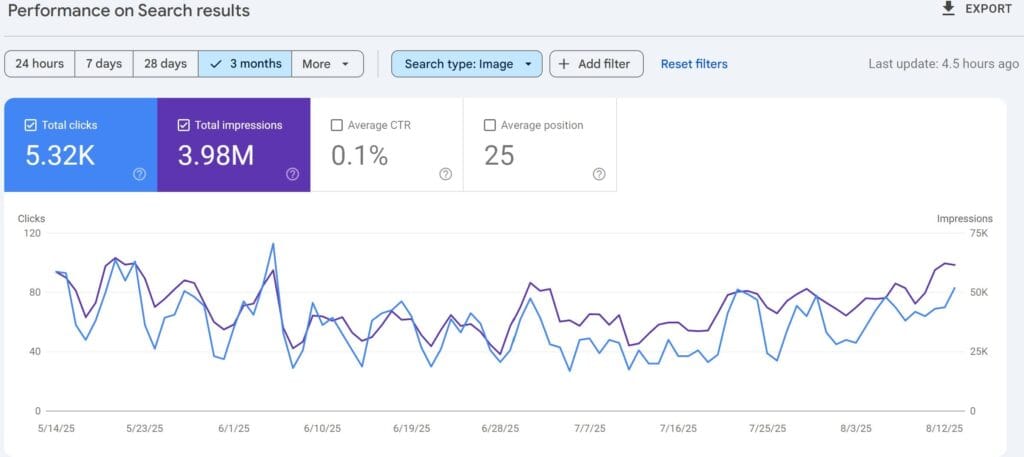
Then look in Google Search Console –> Search results report. Filter by type:image
Checklist so you know if your image is unique and SEO friendly
1. Is the image already on other sites?
Perform a reverse image search to check. If you know you downloaded the image from a free service like Unsplash, it is not unique.
2. Is the image relevant to the text?
The image should support the page content; pink poodles in an article about sports cars are quite irrelevant…
3. Is the technology optimized?
Use modern formats like WebP and compress the image size without losing too much image quality. If you are somewhat technically skilled, you can automate this. Many modern CMS tools have built-in support or plugins that can compress images when they are uploaded. But be careful to check the image size before uploading. An image that is 4000 px wide for the web does more harm than good.
4. Does the image have the correct alt-text and filename?
Describe the images with relevant keywords and provide a relevant filename.
5. Does the image spark interest?
Ask yourself if a visitor would want to click to see more. Images today are also used to push content on social media, so they need to stand out and capture interest quickly.
Some things you definitely want to avoid
Even though AI images themselves do not negatively affect ranking, they can do so indirectly if not handled correctly. Common mistakes are:
- Uploading images in unnecessarily high resolution, which prolongs loading time.
- Using the wrong file format (e.g., uncompressed PNG where WebP is good at compressing and a recognized web standard).
- Forgetting alt texts, which prevents Google from understanding the image content.
- A filename that is not relevant
Quality and credibility are decisive factors
For the visitor, it is important that the images match reality. In e-commerce, a misleading image can lead to dissatisfied customers and ultimately poor reviews. Even AI-generated images must therefore be carefully reviewed to ensure that they are representative and convey the right feeling.
Popular AI tools for image generation
To create unique AI images, you can use several established AI tools:
- Midjourney – advanced and creative image results via Discord. My go-to tool because of quality and also speed.
- DALL·E – easy to use and integrated into ChatGPT.
- Stable Diffusion – open source, perfect for those who want full control. My choice when it comes to granularity and flow. A bit more complicated since it runs locally on your computer, but it is something beyond the ordinary once you get comfortable.
- Canva – user-friendly for quick AI images and design.
- Adobe Firefly – professional AI tools directly in Photoshop and Illustrator.
It is not AI that is the culprit but which images you choose
Google makes a clear distinction: it is not AI that is viewed negatively – but low quality. AI can be a powerful tool for creating visual content, but it does not replace the need for thoughtfulness, quality, and understanding your target audience.